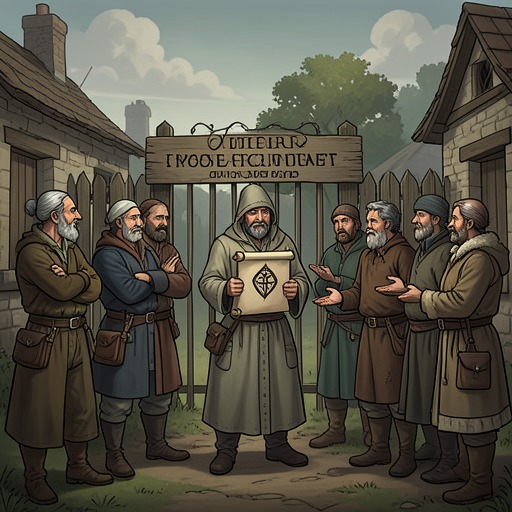
Shasta's Servitude in Arsheesh's Household
The Horse and His BoyShasta's servitude in Arsheesh's household is the first form of unfreedom he knows: a life of domestic labor, dependence on a volatile guardian, and no assurance that the man he calls father will protect him. Its decisive turn comes when Arsheesh entertains selling him to a Tarkaan. The proposed sale exposes both the household's exploitative basis and the truth that Shasta is not Arsheesh's child, turning a revelation about his origins into the opening of his escape.
Identity and Conditions of the Household
Arsheesh is a poor fisherman living with Shasta in a cottage beside a small sea creek in Calormen. Their days follow the work of subsistence: Arsheesh fishes in the morning, then loads his donkey cart with fish and travels to a village to sell them. Shasta, meanwhile, has a long list of household duties. He mends and washes the nets, cooks supper, and cleans the cottage. The arrangement gives him the work and dependence of a household servant, even though he calls Arsheesh Father.
Arsheesh's treatment of Shasta is tied to his own fortunes but remains outside the boy's control. When the fish sell well, Arsheesh may return in a moderately good temper and say nothing to him. When sales go badly, he finds fault and may beat him. The household offers no stable protection from punishment: the same boy's labor is expected each day, while his treatment shifts with the outcome of Arsheesh's trading.
Labor, Discipline, and Limited Freedom
Shasta's duties are not incidental chores. Arsheesh later uses the labor's value as an argument in bargaining over the boy's price, saying that a sale would require him to buy or hire someone else to do the work. That calculation makes explicit what daily life has already shown: Shasta's usefulness to the household is measured in service, and Arsheesh treats the loss of that labor as a cost to be compensated.
Shasta's freedom of movement is also restricted. The country to the north draws his attention, but he has never been allowed to go there. When he asks Arsheesh what lies beyond the nearby hill, the response depends on the fisherman's mood: he may box Shasta's ears and order him back to work, or dismiss the question with a proverb about business and folly. The prohibition is not explained by any known danger. Arsheesh does not know what lies north and does not care; the restriction reflects his practical indifference rather than knowledge he is trying to protect.
The Proposed Sale and the Discovery of Shasta's Origins
The household's precarious father-and-son language becomes unmistakably transactional when a Tarkaan arrives and asks to buy Shasta. Arsheesh initially protests that the boy is his only child and his own flesh, but the Tarkaan challenges the claim, pointing to the difference in their complexions. Arsheesh then admits that he never married and has no child of his own. He says that he found Shasta alive in a small boat brought to shore by the tide, alongside a man who appeared to have died after extreme hunger and thirst. Arsheesh's account describes the infant's apparent rescue; it does not establish the identity of the man or the child's parents.
The Tarkaan refuses to dwell on Arsheesh's self-praise and instead observes that the fisherman has had ample value from Shasta's labor. Arsheesh responds by making that labor central to the price. The Tarkaan offers fifteen crescents; Arsheesh demands seventy, presenting the negotiation as if he were defending a beloved child while calculating the cost of replacing a worker. Shasta leaves before the bargaining concludes. From having listened to similar negotiations in the village, he expects an eventual compromise between the two figures, but does not stay to hear it.
Shasta's Response and the Opening of Escape
Shasta does not experience the proposed sale as the loss of a secure family life. His life in the cottage has already seemed little better than slavery, and he has never been able to love Arsheesh as he believes a son ought to love his father. Learning that they are not related therefore brings relief as well as uncertainty. The story of the boat fills him with excitement: if Arsheesh is not his father, Shasta imagines that he might have come from a very different family or station. These possibilities are hopes, not established facts about his birth.
The stranger's proposed purchase nonetheless presents a serious unknown. Shasta wonders whether a lord's household might offer better conditions, or whether he could be forced into hard labor. The talking horse Bree gives him a direct warning: the Tarkaan, Anradin, is bad, and although a costly war horse is not treated too harshly, Shasta would be better off escaping than becoming a human slave in the Tarkaan's house. Bree's own account makes the comparison concrete: he was captured as a foal and spent years among humans hiding that he could speak, because discovery would have cost him his chance to escape. His experience gives Shasta a route away from one uncertain master, not a promise that freedom will be easy.
The escape also brings practical questions about survival. When Shasta asks whether using money would be theft, Bree first acknowledges that a free, talking horse should not steal, then reasons that they are prisoners in enemy country and that the money is booty; they also need it to obtain food for Shasta, who cannot live on grass and oats as the horses can. Their decision underscores the material difference between being free and merely leaving a household: the fugitives must secure food and travel through hostile territory.
Servitude as a Wider Social Condition
The story places Shasta's household experience within a society that takes enslavement and service for granted. In a later conversation about war, Rabadash compares conquering Narnia to hanging an idle slave or sending a worn-out horse to be made into dog meat. His language groups enslaved people and animals under the authority of masters who judge their usefulness. It echoes the structure of Shasta's life, in which Arsheesh relies on the boy's work and a Tarkaan can propose buying him, even though the boy himself has no meaningful part in the negotiation.
Shasta's early servitude also contrasts with the freedom he seeks beyond Calormen. Bree speaks of Narnia as a happy land and recalls that he was stolen after straying south from Archenland. His history shows that the horses, too, can be captured and compelled to conceal their nature. Later, after the encounter with the lions, Bree condemns himself for running while Shasta went back toward danger; he says he is fit to return to slavery. The statement reveals how shame and fear can make a free life seem undeserved, even when the evidence shows that Bree's choice to flee arose from terror rather than a settled desire for bondage.
Retrospective Meaning
When Shasta later tells the mysterious Voice of his life, he includes his upbringing by the fisherman among a much wider account of escape, danger, and travel. The Voice identifies itself as the lion who pushed the boat carrying the near-dead infant toward the shore where Arsheesh was awake to receive it. It also claims responsibility for several later encounters that shaped Shasta's journey. The revelation changes the meaning of the boat story: what had seemed to Shasta a fortunate rescue becomes part of a larger pattern of guidance, though the Voice insists on telling him his story rather than another person's.
The account of Aravis gives the same lion encounter a separate moral consequence. The lion tells her that it wounded her because the suffering matched the stripes imposed on her stepmother's slave after Aravis drugged the woman into sleep. This does not make Shasta's household and Aravis's actions the same circumstance; it does place the story's treatment of servitude beside a question of responsibility toward an enslaved person. Shasta's life with Arsheesh begins with dependence imposed on a child and the conversion of his labor into a bargaining point. His departure begins when that dependence is exposed as neither kinship nor safety, and when escape becomes a concrete alternative.